


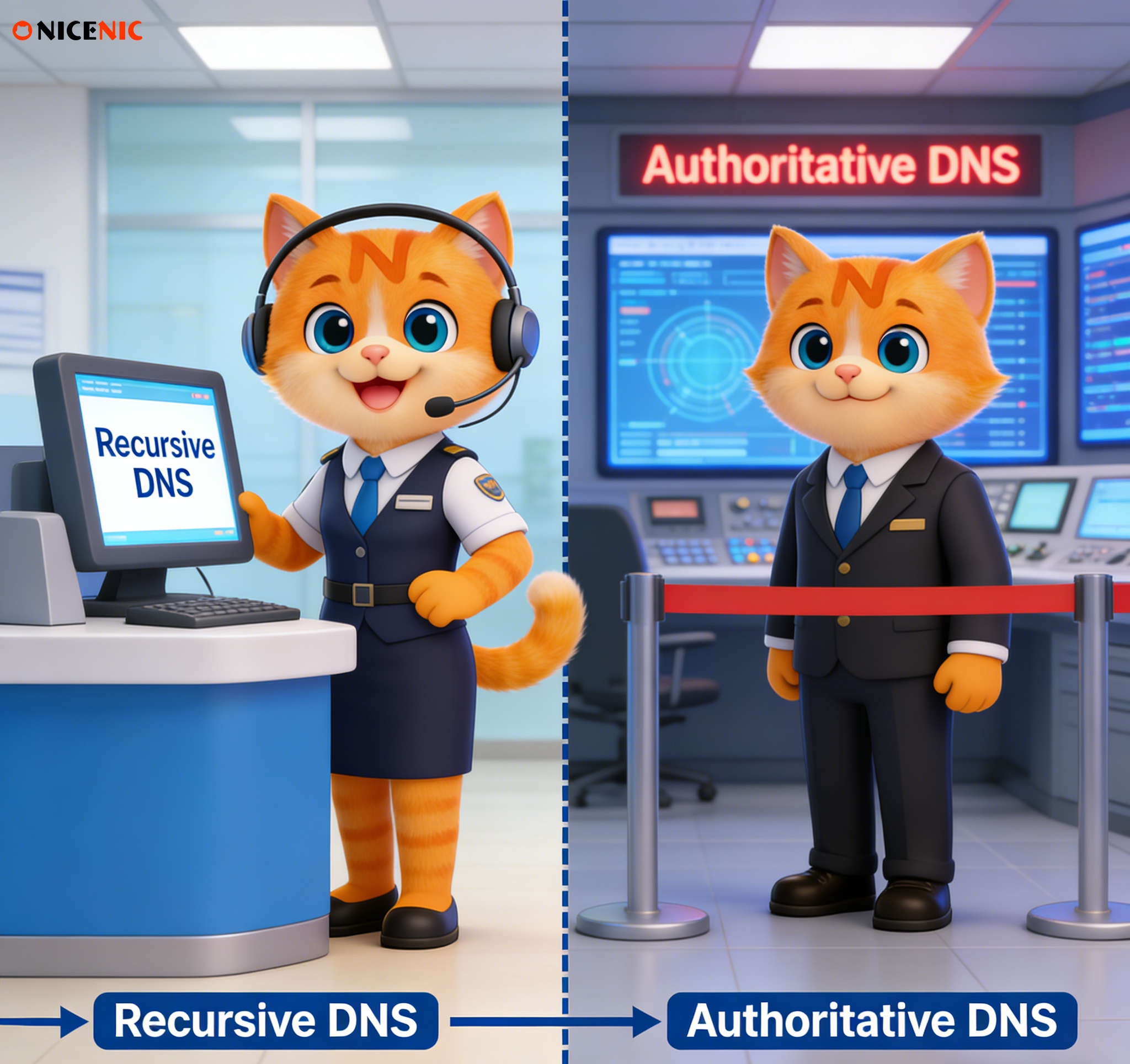
Many DNS issues feel inconsistent and confusing:
-
Clearing local DNS cache works for some users, but not others
-
One network can access a site while another cannot
-
Switching public DNS servers changes nothing
These situations often happen because not all DNS problems exist at the same layer.
Understanding the difference between recursive DNS and authoritative DNS explains why some fixes work and why others do not.
How a DNS Lookup Actually Works
When you type a domain name into a browser, the DNS system does not respond in a single step.
A simplified flow looks like this:
-
Your device sends a query to a recursive DNS server
-
The recursive DNS server looks for the answer
-
If needed, it queries the authoritative DNS server
-
The authoritative DNS server provides the final answer
-
The recursive DNS server caches the result and returns it to you
In short: Recursive DNS looks up answers.
Authoritative DNS provides final answers.
What Is Recursive DNS?
Recursive DNS servers act as searchers and intermediaries.
They are responsible for:
-
Receiving DNS queries from users
-
Locating the correct authoritative DNS servers
-
Caching results to speed up future lookups
Common examples of recursive DNS include:
-
ISP-provided DNS servers
-
Public DNS services (such as Google DNS or Cloudflare DNS)
-
Corporate or internal network DNS servers
Key characteristics of recursive DNS:
-
It does not own DNS records
-
It relies on authoritative DNS for final answers
-
It caches results based on TTL values
Authoritative DNS servers are the source of truth for a domain.
They:
-
Store the actual DNS records (A, MX, CNAME, TXT, etc.)
-
Provide the final, authoritative response to DNS queries
-
Do not cache results from other servers
If a DNS record is incorrect, missing, or misconfigured at the authoritative level, every recursive DNS server will eventually return the same wrong result.
Authoritative DNS is where configuration errors live and where they must be fixed.
Why Clearing DNS Cache Sometimes Works and Sometimes Doesn’t
This is the question behind many DNS support requests.
When Clearing Cache Can Help
If the problem exists at the recursive DNS layer, clearing cache may work.
Examples:
-
Old IP addresses still cached
-
TTL has not yet expired
-
Local or ISP DNS has outdated data
In these cases:
-
Clearing local cache
-
Restarting network equipment
-
Switching recursive DNS servers
may temporarily resolve the issue.
When Clearing Cache Will Not Help
If the problem exists at the authoritative DNS layer, clearing cache will not help.
Examples:
-
DNS records are missing or incorrect
-
Nameservers point to the wrong DNS provider
-
DNSSEC is misconfigured
-
Required records were never created
In these cases, recursive DNS servers are simply returning the wrong final answer they received. Clearing cache does not change the source of truth.
Common Misunderstandings That Cause Repeated Issues
-
"Changing to a public DNS will fix it."
-
"Clearing cache refreshes DNS globally."
-
"All DNS problems are the same."
-
"Authoritative DNS also caches data from elsewhere."
These assumptions often lead to repeated troubleshooting without addressing the real cause.
How to Tell Which DNS Layer Is the Problem
A simple way to narrow it down:
-
If different networks return different results, the issue is often recursive DNS caching
-
If all networks return the same wrong result, the issue is almost always authoritative DNS configuration
Understanding the layer determines the correct fix.
DNS involves multiple responsibilities:
-
Registrar: Manages domain registration and nameserver delegation
-
Authoritative DNS: Stores and serves DNS records
-
Recursive DNS: Queries and caches DNS answers
A registrar does not control recursive DNS behavior and does not create DNS records automatically. Its role is to ensure correct delegation and provide access to DNS management tools.
Why does clearing DNS cache not fix my issue?
Because the problem may exist at the authoritative DNS level.
Why does switching DNS servers not help?
Recursive DNS servers all rely on the same authoritative DNS data.
Which layer does TTL affect?
TTL primarily controls caching behavior at the recursive DNS level.
Final Thoughts
DNS problems are not solved by guessing, they are solved by understanding where the problem exists.
Recursive DNS determines how answers are retrieved and cached.
Authoritative DNS determines what the correct answer actually is.
Knowing the difference prevents unnecessary changes, reduces downtime, and leads to faster resolution.
As an ICANN-accredited registrar, Nicenic helps users clearly distinguish between DNS layers, so troubleshooting efforts focus on the correct source instead of trial-and-error fixes.
Nicenic stands as that trusted partner for brands, developers, entrepreneurs, and businesses worldwide.
Suggested Related Reading (Internal Links)
Next News: Why Changing Nameservers Is Riskier Than Editing DNS Records