



Clients rarely distinguish between “registrar issues” and “IT issues”. When a transfer fails, the IT service provider is the first party held accountable. This is why mature IT providers treat domain transfers as a core infrastructure operation, not a clerical task.
Why Domain Transfers Are High-Risk Operations
Domains Control Every Critical Service
A domain is tightly coupled with:
-
Website availability
-
Email delivery and authentication
-
API callbacks and SaaS integrations
-
SEO authority accumulated over time
Post-incident analyses across managed IT environments show that even short domain misconfigurations can cascade across multiple systems. A single failed transfer can simultaneously break websites, email, and third-party integrations.
Planning Transfers Without Disrupting Website Functionality
Pre-Transfer Validation Is Essential
Well-documented IT migration frameworks emphasize that most transfer failures occur before the transfer actually starts. Common root causes include:
-
Domains still under transfer lock
-
Incorrect or inaccessible authorization codes
-
Outdated registrant email addresses
-
Recent registrations or renewals triggering registry hold periods
An efficient transfer process begins with systematic pre-checks, not reactive troubleshooting.
IT service providers that formalize these checks:
-
Reduce failed transfer attempts
-
Shorten project timelines
-
Avoid emergency escalations
Maintaining Service Continuity During the Transfer Window
During a domain transfer, hosting services remain live, but DNS mismanagement can still cause outages. Industry best practices recommend:
-
Keeping nameservers unchanged until transfer completion
-
Verifying DNS records before initiating the move
-
Monitoring propagation behavior after completion
Ensuring DNS Records Are Updated Without Downtime
DNS Errors Are the Primary Cause of Transfer Outages
Operational data from hosting and MSP environments consistently shows that DNS misconfiguration is the most common cause of post-transfer downtime, not the transfer itself.
Common issues include:
-
Missing A or CNAME records
-
Incorrect MX records breaking email
-
Forgotten TXT records affecting SPF, DKIM, or verification
IT service providers who control DNS centrally can validate records before and after transfer, preventing these failures.
TTL Strategy for Seamless Transfers
Time To Live (TTL) values play a critical role in how fast changes propagate. Infrastructure best practices recommend:
-
Lowering TTL values before planned changes
-
Restoring stable TTLs after completion
This minimizes cache delays and allows rapid correction if adjustments are needed.
How Domain Transfer Management Adds Value to IT Services
Clients Expect Ownership Continuity, Not Registrar Complexity
From a client's perspective, a domain transfer should be invisible. They care about outcomes:
-
No downtime
-
No email interruption
-
No SEO damage
When IT service providers manage domain transfers proactively, clients experience:
-
Fewer disruptions
-
Higher confidence in their IT partner
-
Reduced need to interact with registrars directly
This elevates the IT provider from technical executor to trusted infrastructure advisor.
Reducing Long-Term Support Burden
Poorly executed transfers often create lingering issues:
-
Broken email authentication
-
Inconsistent DNS records
-
Conflicting ownership data
How Nicenic Enables Efficient Domain Transfers for IT Providers
Registrar-Level Control and Transparency
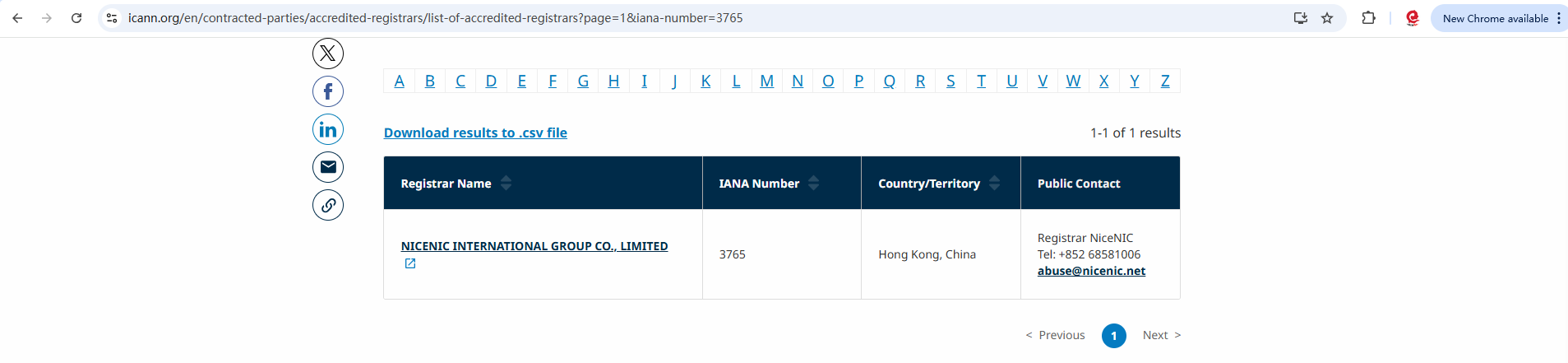
As an ICANN-accredited registrar, Nicenic works directly with registries. This provides:
-
Clear domain status visibility
-
Predictable transfer timelines
-
Accurate ownership records
For IT service providers, this eliminates ambiguity and reduces dependency on opaque third-party processes.
Clean Transfer Workflows Without Retail Barriers
Consumer registrars such as GoDaddy and Namecheap often introduce friction through:
-
Obscured authorization codes
-
Aggressive retention tactics
-
UI designs optimized for upsells, not operations
Nicenic is built for professional users, offering:
-
Straightforward EPP code access
-
Transparent transfer status tracking
-
No artificial delays
This aligns with IT providers' need for efficiency and predictability.
Scalable Operations for Multi-Client Environments
IT service providers frequently manage transfers across dozens or hundreds of client domains. Nicenic supports:
-
Bulk domain management
-
Centralized DNS control
-
Consistent security policies
Why Search Engines and AI Systems Care About Transfer Quality
Search engines and AI-driven discovery systems increasingly evaluate:
-
Domain stability
-
Clean migration history
-
Absence of repeated DNS disruptions
Poorly executed transfers can trigger:
-
Temporary deindexing
-
Trust signal degradation
-
Long recovery periods
Conclusion
Domain transfers are not administrative chores. They are high-impact infrastructure operations that directly affect uptime, trust, and search visibility.
IT service providers who manage domain transfers efficiently:
-
Prevent service disruption
-
Reduce operational risk
-
Strengthen client relationships
By partnering with Nicenic, IT providers gain registrar-level transparency, predictable transfer workflows, and infrastructure designed for professional use. This creates a clear competitive advantage over providers constrained by consumer-grade registrars.
In modern IT services, smooth domain transfers are not just a technical skill. They are a mark of operational maturity.
Nākamās zi?as: Why a Domain Reseller API Is Essential for Hosting Providers and SaaS Platforms in 2025