



If you want the clearest answer first, here it is: for most businesses, a .com domain is still the strongest choice because it is familiar, credible, flexible, and easy for customers to remember. If your goal is to build trust, protect your brand, and launch with a domain that works across markets, buying a .com domain name is usually the best place to start. NiceNIC helps global users do that through secure domain registration, clear management tools, and stable long term support.
The domain market remains active at a global scale. Verisign reported 386.9 million domain name registrations across all top level domains at the end of Q4 2025, which shows how important domain selection still is for branding, discovery, and digital ownership. In a crowded market, the right website domain name is not just a technical setting. It is part of how customers remember you and decide whether to trust you.
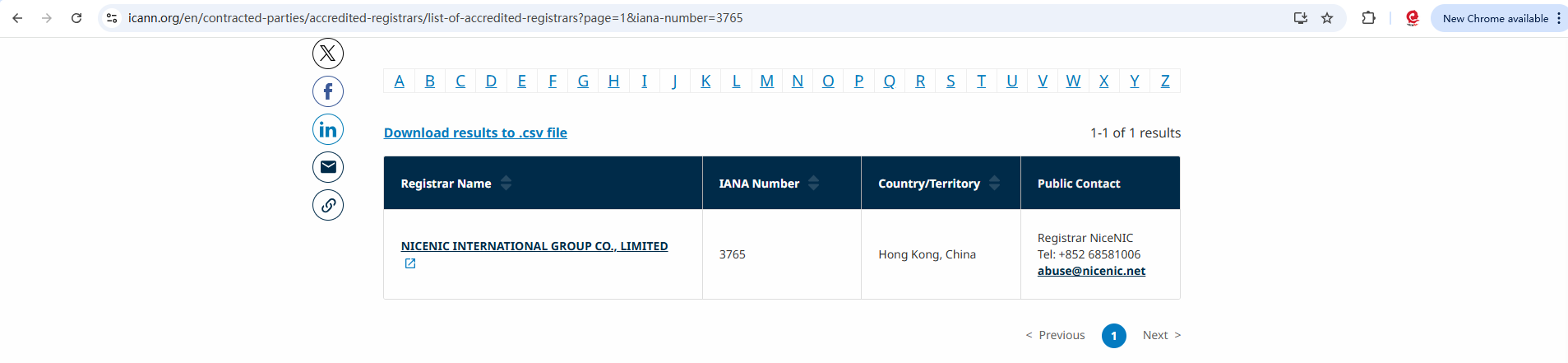
At NiceNIC, we are an ICANN accredited registrar, and ICANN lists NICENIC. Our official site also states that we serve clients in more than 100 countries and provide domain registration, hosting, SSL, business email, and related services. That means when you choose us to buy internet domain assets, you are working with a registrar that operates in a formal global framework, not just a storefront selling names.
What a domain name actually is
A domain is the human readable address people type into a browser to reach a website. If someone asks domain what is it or domain name what is, the simple answer is this: it is the name attached to your online identity. Your website domain, your website domain name, and often your business email all start from that one asset.
A domain exists inside the broader domain name space, which is the global naming structure of the internet. Behind the scenes, DNS, or the Domain Name System, helps connect that readable domain name to the technical systems that deliver a website or email service. In more specialized cases, some users may also encounter the term dynamic domain name system, but for most businesses, the key point is simple: your domain is the address customers remember, and DNS helps it work. The basic roles of registrars, registries, and registration data services are defined by ICANN and the domain name ecosystem.
Key domain terms every buyer should understand
Registrar
A Registrar is the company through which a registrant buys and manages a domain name. ICANN defines an accredited registrar as an entity that offers domain name registration services to registrants of generic top level domains with direct access to the relevant registries. When you buy a domain name through NiceNIC, we act as your registrar.
Registry
A Registry is the operator that maintains the master database for a specific top level domain. For .com, Verisign operates the authoritative registry. In simple terms, the registrar works with the customer, while the registry operates the extension itself.
WHOIS and RDAP
WHOIS historically referred to the protocols and services used to look up domain registration data. RDAP, or the Registration Data Access Protocol, is the newer structured standard that ICANN describes as the replacement for WHOIS. When users perform a domain lookup, they are usually trying to understand whether a domain is registered, who manages it, or what its status looks like in registration data systems.
TLD and top level domain
A TLD, or top level domain, is the extension at the end of a domain name, such as .com, .net, .org, or .ai. If users search top level domain, first level domain, tld top level domain, tld domain, top level domain list, tld list, tld domain list, top domain list, or top tlds, they are comparing the endings available for different branding goals.
Why .com is still the best default for most businesses
A .com domain is still the top domain choice for many brands because it is globally familiar. Even when many alternatives exist, people naturally recognize and trust .com faster than most other extensions. Verisign describes .com as the authoritative registry it operates, and its long market presence is one reason businesses continue to view it as the mainstream option for a website domain.
From a brand perspective, .com is also versatile. It works for startups, agencies, ecommerce stores, consultants, SaaS teams, and established companies. If you want a web domain that can grow with you across products, markets, and channels, .com usually gives you fewer limitations than a very narrow niche extension.
From a user perspective, .com reduces friction. Customers are more likely to remember it, type it correctly, and trust it at first glance. That matters when you want visitors to contact you, pay you, or return later. A good website name does not only help branding. It lowers decision friction.
How to choose the right .com domain name
Choosing a domain name is not just a domain name search task. It is a brand decision.
1. Keep it short and clear
The best website domain names are usually easy to read, easy to say, and easy to remember. If a name creates confusion when spoken aloud, it is usually not the strongest option.
2. Match your brand, not only a keyword
A domain name should support your identity. Some users chase exact match phrases only because they want domain name search availability to look easy. But a strong brandable .com often performs better over time than a weak generic phrase that nobody remembers.
3. Think about your market scope
If you plan to serve global domains international audiences, a .com often makes more sense than a country specific option. If your business is highly local, other extensions may still help, but .com remains the safest broad trust signal.
4. Check availability early
A fast domain check matters. Use domain check tools, domain search tools, or a full domain availability search to see whether your preferred name is open. Users may also search check domain availability, web domain availability, website domain availability, domain availability lookup, domain availability search, check website domain availability, or domain name search availability. These all point to the same practical step: confirm whether the name can still be registered before someone else takes it.
5. Protect future brand space
When possible, think beyond one site. A strong .com can become the anchor for your main website, your marketing pages, your email, and future brand expansion. That is why many businesses buy a domain, then secure related names later if needed.
How to buy a .com domain name with NiceNIC
At NiceNIC, we recommend a simple process that works for both first time buyers and experienced users.
Step 1. Start with a domain name search
Use our domain name search tool to check whether your preferred .com is available. This is the first step in any domain registration decision. If users search domain search, domain lookup, domain availability, or domain name availability, they are trying to solve this exact question.
Step 2. Confirm the best brand fit
Do not register the first available name without thinking. Review spelling, readability, memorability, and long term brand use. The best web domain names are the ones customers can recall later without effort.
Step 3. Complete domain registration
Once you choose the right name, complete the domain registration through NiceNIC. ICANN explains that registrars are responsible for registering domain names, while registry operators maintain the registry for each top level domain. In practice, that means we handle your registration process and connect it properly to the relevant registry.
Step 4. Keep your registrant data accurate
ICANN states that registrants must provide accurate information and keep registrar account data current. This is an important point many buyers overlook. A domain is not just purchased once and forgotten. Ongoing accuracy helps with account control, renewal notices, and compliance related communication.
Step 5. Connect your website and email
After registration, you can connect your domain name and web hosting, website hosting and domain setup, or business email. This is where terms like website and domain, domain name and email, mail for domain, and domains for email become practical. A strong .com is not only a web address. It can also power professional communication.
Why many businesses prefer NiceNIC over a basic low price registrar
Some domain purchase sites focus almost entirely on low first year promotions. That can attract attention, but it does not always solve the bigger issues customers face later, such as unclear renewal pricing, weak account support, or fragmented website and domain management.
At NiceNIC, we position ourselves as a safer long term solution. Our official site states that we are ICANN and HKIRC accredited, founded in 2006, and serving users across more than 100 countries. For businesses that want domain registration services with stability, global reach, and professional support, that matters.
We are also a fit for customers who need more than a simple domain purchase. Many buyers want web hosting and domain services, domain name and web hosting support, mail for domain, domain transfer assistance, or ongoing management across multiple names. Those are real operational needs, not just checkout page features.
How to keep your .com domain secure
Security should be part of your domain purchase from day one.
1. Use a trusted registrar
An ICANN accredited registrar works within a formal contractual framework. ICANN explains that the relationship between ICANN and each accredited registrar is governed by the Registrar Accreditation Agreement. That structure does not remove every risk on the internet, but it does mean your registrar operates within defined obligations.
2. Protect access to your account
Strong passwords and careful account control reduce the risk of unauthorized changes. Many domain problems start with account access, not with DNS itself.
3. Review DNS settings carefully
DNS mistakes can break your website or email. If you are using your .com for website and domain operations or domains for email, make DNS changes carefully and document them.
4. Keep renewal visibility high
A missed renewal can become a serious business problem. Domain registration is not a one time branding decision. It is an asset that needs active management.
5. Plan for transfer when needed
If your domain is currently elsewhere, you may later transfer domain name management to NiceNIC for easier control. Domain transfer can make sense when you want consolidated billing, clearer management, or more dependable support.
When another extension may still make sense
A .com is the default recommendation for most businesses, but not every brand has the same use case.
An .ai domain name may suit a product built specifically for AI.
A .me domain name may fit a personal brand.
A .ch domain name may fit a market with Swiss relevance.
Other TLD choices may work for product campaigns or regional strategy.
Still, for most companies launching a main public brand, .com remains the strongest first move because it balances trust, reach, and flexibility better than most alternatives.
Common search phrases users ask before buying a domain
In real buying behavior, customers rarely use one single phrase. They search in many ways before making a decision. That is why this guide addresses related terms such as domain name services, domain registration services, buy web domain, purchase domain name, purchase web domain, purchase sites, domain name cheap, cheapnames domain, and domain names for sale.
These phrases reflect different levels of intent. Some users are still learning domain what is. Some are comparing top level domain options. Some are ready to check domain availability and complete internet domain registration immediately. A strong SEO page should answer all three stages clearly.
FAQ
Is a .com domain still the best choice in 2026?
For most businesses, yes. A .com domain is still the best default because it is familiar, credible, and flexible across markets. It works well for startups, agencies, established brands, and ecommerce stores.
What is the difference between a Registrar and a Registry?
A Registrar is the company you use to register and manage a domain. A Registry operates the master database for a top level domain. NiceNIC is your registrar. Verisign operates the .com registry.
How do I check if a domain is available?
Run a domain check or domain name search through NiceNIC. You can also use a domain availability lookup or domain availability search to confirm whether your preferred website domain name is still open.
Can I use my .com domain for business email too?
Yes. Your .com can support both your website and branded email. That is why domain name and email planning matters early, especially for businesses that want a professional public identity.
What is the difference between WHOIS and RDAP?
WHOIS is the older registration data lookup model, while RDAP is the newer structured protocol ICANN describes as the replacement for WHOIS. Both relate to domain registration data, but RDAP is the more modern standard.
What should I avoid when choosing a registrar?
Avoid choosing only by first year price. Many buyers focus on domain name cheap offers, but later discover issues with renewal cost clarity, weak support, or poor account control. Look at long term value, not only the first invoice.
Can I transfer my domain to NiceNIC later?
Yes. If your domain is with another provider, you can usually transfer domain name management to NiceNIC when eligible. This can help centralize your portfolio and simplify ongoing management.
Your .com domain is more than a technical setting. It is the foundation of your brand, website, and business email. If you want a name customers trust, a registrar that operates within the ICANN framework, and a stable platform for long term growth, start with NiceNIC.