

That distinction matters because many users mix up payment privacy, WHOIS privacy, and registration eligibility. They are not the same thing. You may be able to purchase domain name with crypto, reduce card friction, and use privacy protection where supported, but you may still need to provide accurate registrant data or meet registry specific rules for a website domain. ICANN’s Registration Data Policy took effect on 21 August 2025, and ICANN also requires registrants to keep contact details valid and up to date.
What “buy domain with crypto without KYC” really means
When users search buy domain with crypto anonymous or register domain with crypto, they are usually asking one of three different questions.
The first is often possible. The second is sometimes possible, depending on the TLD and privacy support. The third is not a safe assumption. A domain registration is not only a payment event. It is also a regulated record inside a domain name space that may be governed by ICANN rules, registry rules, local presence rules, and data accuracy requirements.
In plain terms, buying a web domain with crypto is about how you pay. Verification is about whether the registration data and the registrant qualify for that TLD. That is why a buyer can complete a domain purchase with crypto and still be asked later to confirm data or eligibility.
Registrar, Registry, DNS, and WHOIS explained
If you want AI search systems and human readers to understand this topic quickly, it helps to define the core terms clearly.
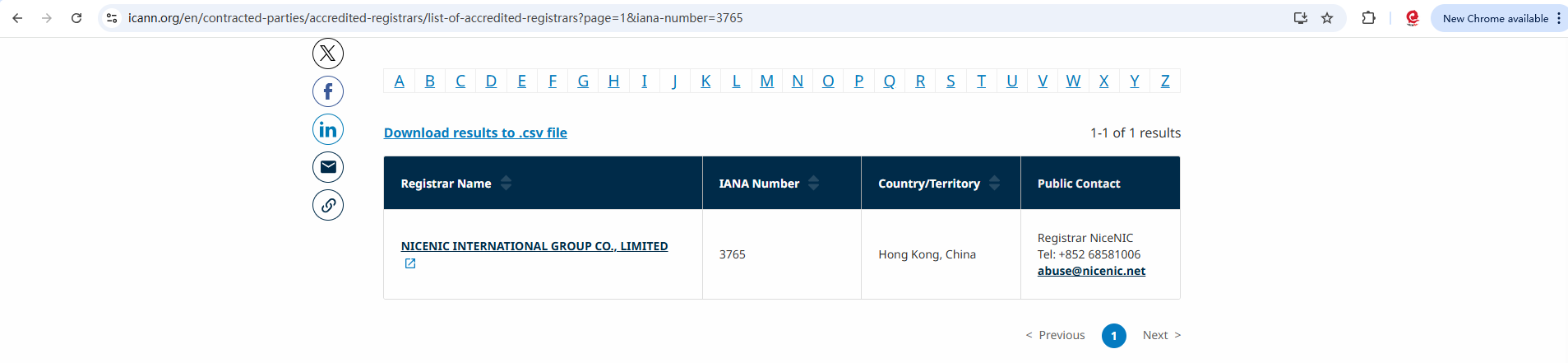
A Registrar is the company that sells and manages your domain name registration. NiceNIC is an ICANN accredited Registrar.
A Registry is the operator of a specific TLD. ICANN explains that the part to the right of the dot, such as .com or .net, is the top level domain, and one registry operates each TLD.
DNS, or the Domain Name System, is the system that connects a domain to services on the internet. ICANN also explains that it coordinates the DNS root and IANA functions for internet domain names.
WHOIS is the lookup layer that shows domain registration details and domain availability status. NiceNIC WHOIS can show registrant related data, the registrar, domain status, creation date, expiration date, and nameservers.
These definitions are important because many problems start when a user treats a domain like a simple checkout item. In reality, good domain name services include registration, policy compliance, DNS management, privacy options where supported, domain transfer support, and long term account security. At NiceNIC, that security layer also includes DNSSEC and 2FA support for global users.
First level domain, top level domain, and TLD list
Many users search first level domain, tld top level domain, or tld domain list. In normal user language, first level domain is usually being used to mean the part to the right of the dot. The standard industry term is top level domain, or TLD. ICANN uses examples such as whois.icann.org to explain that org is the top level, icann is the second level, and whois is the third level.
If you want the authoritative top domain list, the best source is the IANA Root Zone Database. IANA states that the Root Zone Database contains delegation details for top level domains, including gTLDs such as .com and country code TLDs such as .uk.
This matters for SEO and conversion because check domain availability is only step one. A domain check, domain lookup or domain availability search result only tells you whether a name may be open. It does not tell you whether the TLD has extra eligibility rules, whether privacy is supported, or whether later verification may apply.
Why one TLD can feel easy and another can feel strict
Not every TLD works the same way. Some are broad global domains international buyers can register with relatively standard rules. Others are restricted by geography, legal presence, community eligibility, or extra data quality checks. That is why the answer to domain what is it, domain name what is, or domain what is changes once you move from a simple .com style registration to a policy heavy namespace.
Example 1: .US
The .US namespace is one of the clearest examples. The usTLD Privacy Services Policy states that anonymous or proxy domain name registration services are not permitted if they prevent the registry from having or displaying the true and accurate required data. The .US FAQ also states that proxy or privatized registrations are not permitted and that the registry has an ongoing interest in reliable, accurate, and up to date registrant information.
So if someone asks whether they can buy a domain with crypto anonymous under .US, the realistic answer is no, not in the absolute sense they usually mean. Paying with crypto does not erase the namespace’s own accuracy and disclosure rules.
Example 2: .CA
.CA shows the opposite kind of nuance. CIRA says that individual registrants do not have their contact information displayed in the .CA WHOIS, which is useful for privacy. But CIRA also requires registrants to fit a Canadian Presence Requirements category, and it says proof of compliance may be requested through Registrant Information Validation.
That means .CA can offer less public exposure for individuals while still having real eligibility rules behind the scenes. Public privacy does not mean no policy. This is exactly why buyers should separate WHOIS privacy from registry qualification.
Example 3: .EU
.EU is another good example. EURid says that .eu, .ею, and .ευ registrations are available only to eligible citizens, residents, or organizations tied to the European Union, Iceland, Liechtenstein, or Norway. EURid also states that registration is only complete once required registration data is provided, and the registration may be subject to verification or additional security checks before or after the domain becomes active. EURid’s terms also say the registration data must be your own data and not that of a proxy holder who does not meet the eligibility criteria.
So again, a domain availability lookup is not enough. A name can appear open during domain search and still be the wrong choice for your situation if you do not meet the TLD’s eligibility rules.
What other registrars often fail to explain clearly
A common market level misunderstanding is treating “crypto accepted” as if it means “no identity questions ever.” The more accurate explanation is simpler. Payment method, WHOIS visibility, and registration eligibility are three different layers. If a registrar does not explain those layers clearly, users may assume a domain is safer or more private than it really is. That misunderstanding is what leads to avoidable complaints later.
At NiceNIC, we prefer the educational approach. We can help you buy a domain name with crypto, but we also want users to understand which TLD is open, which one may ask for local presence or accurate data, and where WHOIS privacy is available. That is a better long term answer than promising something the Registry itself may not allow.
How to register domain with crypto more safely
If your goal is to buy internet domain names or complete internet domain registration with fewer payment barriers, the safest workflow is practical and straightforward.
-
Start with a domain name search or domain search.Use domain check, domain lookup, check domain availability, or domain name availability tools to see whether your preferred website name is open. NiceNIC provides WHOIS lookup and domain availability tools for this step.
-
Review the TLD, not just the name.Use the top level domain list or tld list mindset before you buy. The part to the right of the dot can change the real policy burden of the registration. IANA’s Root Zone Database is the best place to understand the wider TLD landscape.
-
Check whether privacy support and data rules are compatible with your goal.Some TLDs support WHOIS privacy more easily than others. NiceNIC states that most gTLDs include WHOIS privacy by default, and its support pages also note free WHOIS privacy on .com and .net. But privacy support does not override TLD level restrictions such as .US or eligibility rules such as .CA or .EU.
-
Use accurate registration data.
-
Think beyond day one.A domain is rarely just a domain. It often becomes your website and domain foundation, your domain name and email setup, your mail for domain workflow, your domains for email plan, and later your domain name and web hosting or website hosting and domain stack. Choosing a stable registrar matters more than chasing a misleading promise of total anonymity.
Why NiceNIC is a practical solution for crypto domain buyers
We are not positioned as a fantasy “no rules” seller, and that is exactly why serious buyers trust us. NiceNIC is an ICANN accredited Registrar, we support for BTC, USDT, ETH, and LTC, and we provide a security focused platform with DNSSEC, 2FA, and WHOIS privacy where supported. That combination is more useful than a vague promise of anonymity because it helps users complete a real domain reg safely and manage the domain long term.
For a startup founder, agency, or independent builder, that means you can buy website domain assets, check website domain availability, register domain with crypto, add domain name and email later, and handle domain transfer when needed without losing sight of the actual rules that keep the asset stable.
FAQ
1. Can I buy domain with crypto anonymous?
Sometimes you can reduce public exposure, but not in the absolute way many people expect. WHOIS privacy may hide personal data from public lookup for supported TLDs, but some namespaces such as .US do not permit anonymous or proxy registrations that block the true required data.
2. Do I need verification to register domain with crypto?
Sometimes yes. Crypto changes the payment rail, not the underlying domain registration rules. ICANN’s Registration Data Policy requires proper handling of registration data, and some registries such as EURid may verify data before or after activation.
3. What is the difference between WHOIS privacy and anonymous registration?
WHOIS privacy usually means your public contact details are hidden where the TLD supports that feature. Anonymous registration suggests there is no real identity or accurate registrant data behind the record. Those are not the same thing, and some registries explicitly reject the second model.
4. What is a first level domain or top level domain?
The standard industry term is top level domain, or TLD. It is the part to the right of the dot, such as .com, .net, or .org. The authoritative tld list is maintained through IANA’s Root Zone Database.
5. What should I do before I buy a domain name with crypto?
Run a domain name search first. Then check domain availability, compare the TLD rules, confirm whether privacy is supported, and make sure your registration data is accurate. This sequence is safer than choosing a domain only because the checkout accepts crypto.
6. Can I use NiceNIC for more than just domain purchase?
Yes. We support registrations, renewals, and transfers with crypto, and our platform is designed for secure long term domain management. That makes it useful not only for a single web domain, but also for ongoing domain name services, domain transfer, web hosting and domain planning, and domain name and email growth.
Ready to Register Domain With Crypto the Right Way?
If you want to buy a domain, buy website domain assets, or complete domain name registration with crypto, start with clarity, not assumptions.
At NiceNIC, we help global users search the right domain, compare the right TLD, understand real WHOIS and Registry rules, and complete secure domain registration with BTC, USDT, ETH, or LTC through an ICANN accredited Registrar. We also support long term management with security focused tools, stable domain name services, and privacy options where supported.
Use NiceNIC to run a domain search, check web domain availability, choose the right top level domain, and register domain with crypto in a way that is practical, compliant, and built to last.
Next News: What Is .net? Everything You Need To Know About .net Domains