


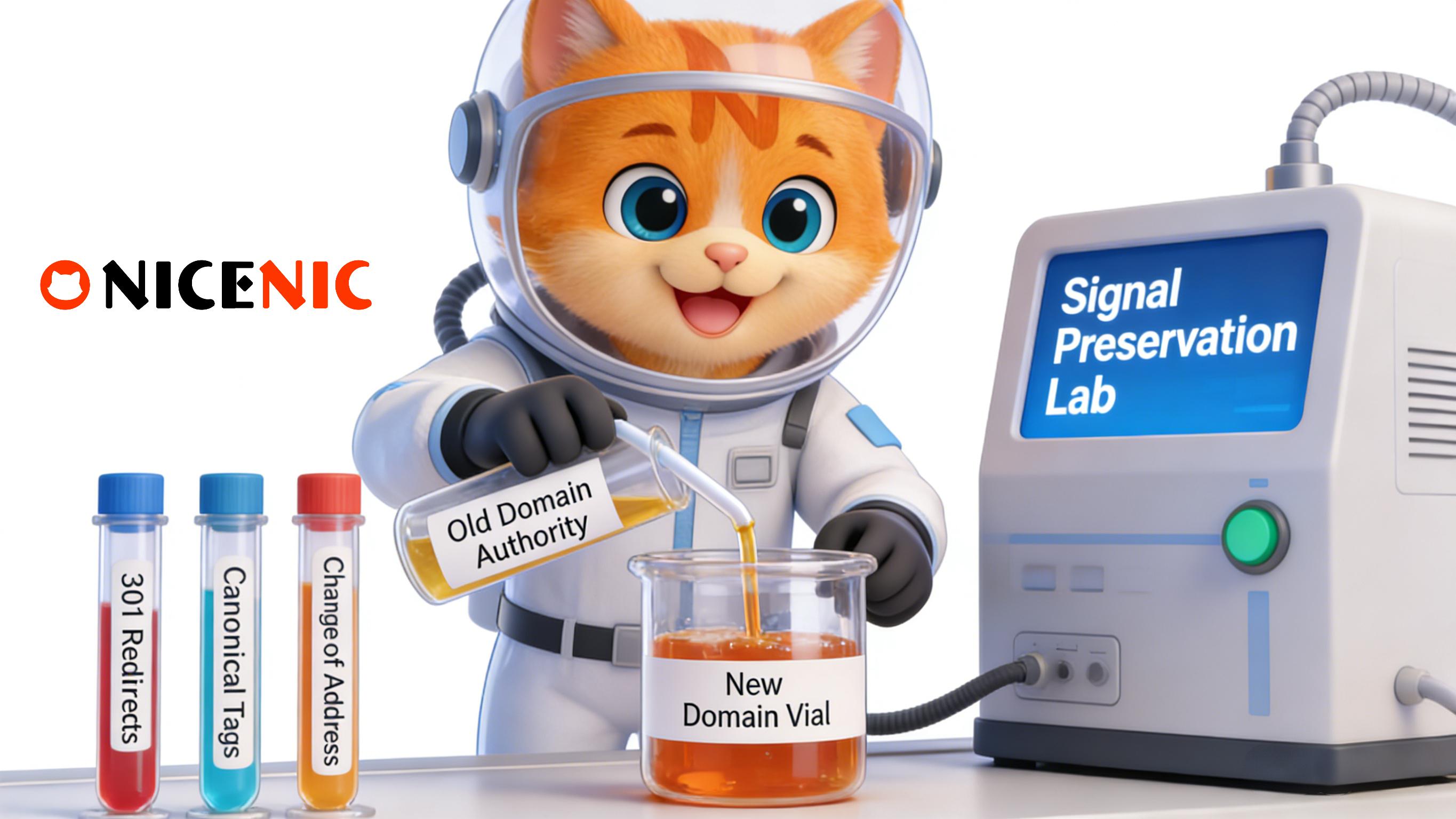
Migrating a website to a new domain is one of the most sensitive operations in SEO. Done correctly, it allows a brand to grow, rebrand, or expand internationally without losing visibility. Done poorly, it can erase years of accumulated rankings, backlinks, and trust signals in a matter of weeks.
At NiceNIC, domain migration is treated as a structured SEO process, not a simple technical switch. Below is a clear, practical explanation of what domain migration really means, how SEO signals behave during a site move, and how to protect your search performance throughout the transition.
What Is Domain Migration
Domain migration refers to moving a website from one domain to another while preserving its content, structure, and SEO value. This can happen for several strategic reasons.
Many companies migrate domains during rebranding, such as moving from a legacy extension to a more globally recognized one. Others migrate to improve SEO clarity by consolidating signals under a stronger primary domain. Some businesses migrate as part of international expansion to better align their digital identity with a global audience.
Regardless of the reason, search engines treat a domain migration as a major structural change. That is why every step must be planned with SEO signals in mind.
Understanding SEO Signals During a Domain Migration
SEO signals are the indicators search engines use to evaluate a website’s relevance, authority, and trustworthiness. During a domain migration, the goal is not to rebuild these signals, but to transfer them intact.
301 Redirects as the Foundation
Permanent 301 redirects are the most critical mechanism in any domain migration. They inform Google and Bing that content has moved permanently and that historical value should be passed to the new URLs.
When implemented correctly, 301 redirects transfer link equity, ranking signals, and existing traffic from the old domain to the new one. Without them, search engines treat the new domain as unrelated, which often leads to ranking loss and traffic decline.
Content Mapping and Relevance Continuity
Every page on the old domain must have a clear corresponding page on the new domain. This one to one mapping preserves topical relevance and helps search engines understand that the content itself has not changed, only its location.
Redirecting unrelated pages or sending all URLs to a homepage weakens SEO signals and increases the risk of ranking volatility. Maintaining content continuity is essential for stable migration outcomes.
Internal Link Updates
Internal links are powerful signals that define site structure and content importance. During migration, all internal links pointing to the old domain should be updated to reference the new domain directly.
This reduces unnecessary redirect chains, improves crawl efficiency, and reinforces the new domain as the authoritative version of the site.
Backlink Retention and Reinforcement
Backlinks remain one of the strongest SEO signals. While 301 redirects pass link equity, direct backlinks are always more efficient.
Reaching out to high value referring sites and requesting link updates to the new domain strengthens authority transfer and reduces long term dependency on redirects. This step is often overlooked but plays a key role in stabilizing rankings after migration.
Why SEO Signals Matter During a Site Move
Search engines do not rank websites based on design or branding alone. They rely on accumulated signals such as backlinks, keyword relevance, historical performance, and site authority.
During a migration, these signals must be preserved to avoid sending conflicting information to search engines. A properly managed migration allows search engines to recognize the new domain as a continuation of the existing site rather than a new or unrelated property.
Preserving SEO signals ensures that years of content investment and link building are not lost during the transition.
Data Driven Insights from Real World Migration
During the NiceNIC to www.unionroom.cn migration, tools such as Google Search Console were used to monitor indexing, crawl behavior, and redirect performance.
Early data confirmed that search engines were correctly processing 301 redirects and associating the new domain with historical ranking signals. Index coverage remained stable and organic traffic levels showed no abnormal drops during the migration window.
This kind of monitoring is essential. Domain migration is not an instant process, but data driven validation ensures issues are identified and corrected before they impact long term visibility.
Best Practices for Preserving SEO During Domain Migration
Successful migrations consistently follow several proven principles.
When these steps are followed systematically, domain migration becomes a controlled SEO operation rather than a risky experiment.
Conclusion
Domain migration is not just a technical change. It is an SEO sensitive process that determines whether your existing authority survives or disappears.
By understanding how SEO signals work and applying best practices such as 301 redirects, content mapping, internal link updates, and ongoing monitoring, it is possible to migrate domains while preserving rankings, traffic, and trust.
With careful planning and the right tools, a domain move can become a strategic upgrade rather than a setback.
Next News: Pending Delete: What Happens When Your Domain Is About to Expire?