


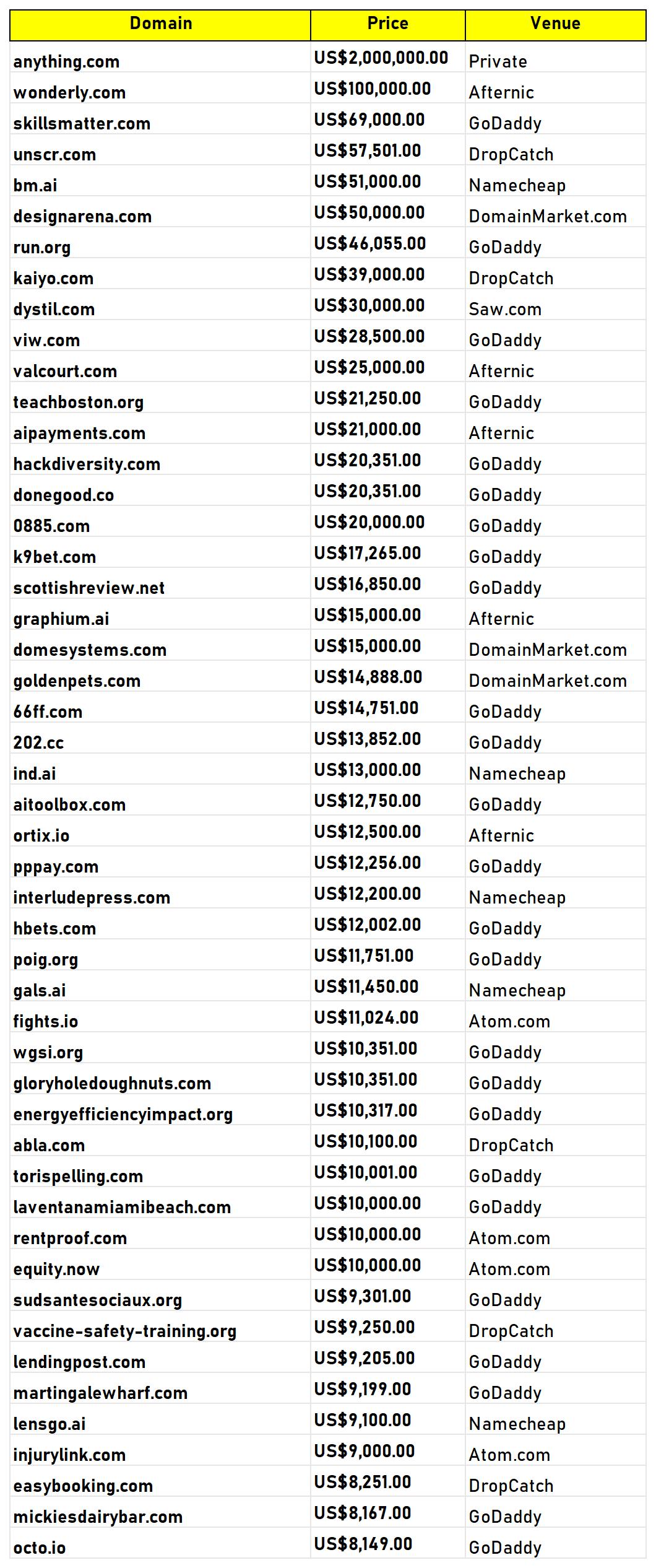
Looking at this week’s NameBio-reported sales, the headline transactions immediately stand out. Anything.com closing at $2 million sets an extreme high-water mark, followed by strong premium sales like wonderly.com at $100K, skillsmatter.com at $69K, and a cluster of mid-to-high five-figure names.
But the more interesting story isn’t the top sale. It’s how the rest of the market structured itself underneath that outlier, and what it tells us about buyer behavior across different niches and extensions.
All of the data discussed below comes from the same recent reporting window, giving us a clean snapshot of current market dynamics rather than a mix of old and new trends.
1. Breaking the Sales Down by Niche
When you step back and categorize these transactions by use case, several clear groups emerge.
First are premium brandables and generics. Names like anything.com, wonderly.com, dystil.com, kaiyo.com, designarena.com, and abla.com fall squarely into this category. These are short, flexible, brand-first domains with broad commercial appeal. Not surprisingly, this niche produced both the highest prices and the widest spread.
Second is tech, AI, and automation. Domains such as bm.ai, ind.ai, gals.ai, graphium.ai, ortix.io, fights.io, redstone.ai, and superfast.ai show consistent buyer interest. This niche is less about perfect dictionary words and more about signaling relevance in fast-moving sectors.
Third, we see corporate, B2B, and services-focused names. Examples include skillsmatter.com, aipayments.com, rentproof.com, injurylink.com, domesystems.com, and fullyinsured.com. These are operational names, typically bought by end users with a clear business case rather than by speculative investors.
Another large bucket is local business and hospitality. Restaurant and venue names like laventanamiamibeach.com, sushi-rama.com, mickiesdairybar.com, grandcrubistro.com, and a long list of city-specific brands make up a significant portion of the sales. This niche rarely produces headline prices, but it provides steady volume.
We also see a consistent presence of nonprofit, education, and civic projects, including run.org, darkhorse.org, teachboston.org, crucial.org, and whyopenresearch.org. These names tend to cluster tightly in price and show very predictable behavior.
Finally, there’s a smaller but visible group of numeric and short-code domains, such as 0885.com, 66ff.com, 202.cc, and 0160.com, which appeal to a different buyer base, often region-specific or investment-driven.
2. What the Lower-End Sales Tell Us
Across almost every niche, the lower range of sales sits comfortably between roughly $5,000 and $7,000.
That’s true for brandables, tech names, local businesses, and even nonprofits. This is an important signal. It suggests the market still has a healthy floor, and that sellers with reasonably clean inventory can expect liquidity even outside the premium tier.
For tech and AI domains, the lower end tends to be newer or more experimental terms. For local businesses, it’s often longer names or highly specific venues. In nonprofits, the lower end is simply the norm.
The key point is consistency: the downside risk across niches looks relatively contained right now.
3. Extension Behavior: Single-Extension vs Multi-Extension Niches
One of the clearest patterns in this dataset is how differently niches treat extensions.
Brandables remain overwhelmingly .com-centric. With very few exceptions, buyers in this category still anchor their decisions around .com. Even when alternative extensions exist, .com continues to command the premium.
Local businesses behave the same way. Restaurants, shops, and service providers almost universally choose .com, and this hasn’t changed.
Nonprofits remain loyal to .org. This is one of the most stable extension-to-niche relationships in the entire domain market.
Tech and AI are the outlier. This is the only niche where extension flexibility is not just accepted, but expected. In this week alone, we saw credible sales in .ai, .io, .cc, .co, .re, .net, and even newer or more creative extensions. In this sector, clarity of concept matters more than extension tradition.
4. Timing: Are These Fresh Trends or Old Sales Resurfacing?
All of these transactions fall within the same recent reporting window. That matters, because it removes time distortion from the analysis.
The behaviors we’re seeing aren’t artifacts of older bull markets or post-pandemic spikes. They reflect current demand. And because all niches appear simultaneously in the same window, the differences between them are structural, not seasonal.
5. New Trend or Continuation?
Most of what we see here is a continuation of long-running patterns rather than sudden shifts.
Where the trend continues to evolve is in tech naming. The willingness to adopt .ai, .io, and other non-.com extensions is no longer experimental. It’s now normalized. That trend began several years ago, but weeks like this show it’s still strengthening rather than cooling off.
6. Price Structure by Niche (Low, Middle, High)
At a high level, the price behavior looks like this:
- Brandables range from a solid low around $6K to six and even seven figures at the top, with a very active mid-tier between $25K and $100K.
- Tech and AI domains show one of the widest spreads, roughly from $5K on the low end, into the low five figures for most names, and pushing past $50K for standout assets.
- Corporate and B2B names cluster higher than many people expect, often living comfortably between $10K and $25K.
- Local business names mostly stay between $6K and $10K, with occasional spikes when the brand is particularly strong or the location is valuable.
- Nonprofit domains tend to sit in a narrow band, usually between $5K and $7K, with rare outliers.
This variance tells us where speculation and upside live, and where stability dominates.
7. What This Means for Buyers and Registrants
If you’re building or investing in tech or AI brands, extension flexibility is now part of the strategy. Being locked into a .com-only mindset increasingly limits options.
If you’re focused on brandables, premium .com still dominates, but competition at the high end remains intense.
If your interest is in local or SMB domains, the market is steady, predictable knowable, and far less speculative.
And if you operate in the nonprofit or academic space, .org remains one of the most consistent and least volatile parts of the entire domain ecosystem.
8. Why ccTLD Access Matters in This Environment
From a registrar’s perspective, this week reinforces something we’ve been seeing for a while: as soon as buyers move outside traditional .com logic, access to high-quality ccTLDs becomes strategically important.
NiceNIC operates with direct registrar access to a broad set of ccTLDs, including .hk, .sh, .ac, .io, .cc, .tv, .vc, .la, .tm, .me, .am, .at, .cz, .dk, .im, .it, .nl, .se, .sg, .co, .uk, .gg, .je, .ai, .au, .br, .rs and many others.
In practical terms, this gives founders, agencies, and investors:
- Better security through direct registry relationships,
- Faster provisioning and fewer intermediaries,
- Greater long-term control over renewal and policy stability,
- And more flexibility when the ideal .com is unavailable or overpriced.
Weeks like this, where tech buyers comfortably adopt multiple extensions, show why that flexibility is no longer optional.
Final Takeaway
This wasn’t just a week with a big headline sale. It was a week that clearly demonstrated how different parts of the domain market now operate under different rules.
Understanding those distinctions matters far more than tracking any single sale.
If you read the data that way, this week looks less like noise and more like a market behaving exactly as a mature, segmented industry should.
Seuraavat uutiset: Why More Brands Choose Instant Domain Ownership Through NiceNIC