
Your domain name is the backbone of your digital presence. It’s one of the most important things your visitors remember and a critical component of your marketing strategy.
Vistas:1208
Hoa:2025-11-06 15:18:03 Auto: NiceNIC 
Understanding what a domain is, and how it works. It can greatly strengthen your brand’s online impact, especially if you’re building a business or launching a new project.
To help you navigate the process, NiceNIC, an ICANN-accredited global registrar, has prepared this in-depth guide on everything you need to know about domain names and how to register your own.
What Is a Domain Name?
A domain name is the unique name and web address for every website. For example, to visit our site, you type NiceNIC into your browser.
If your website were a building, your domain name would be its street address. Each one is unique and directs visitors straight to your site.
Technically, domain names simplify how people access the web. Instead of typing complex numerical IP addresses (like 192.153.2.46), you use readable text, a name that connects instantly to your brand.
The Structure of a Domain Name
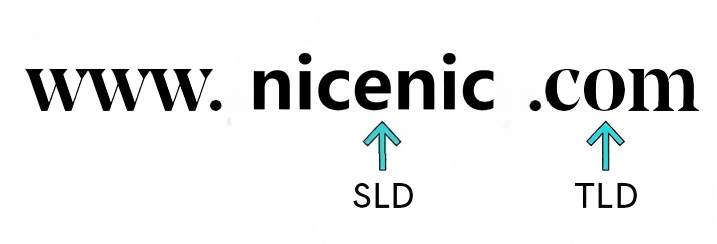
A domain name consists of two main parts: the second-level domain (SLD) and the top-level domain (TLD).
The SLD is the part that comes before the dot (for example, “nicenic” in NiceNIC). Though it can be up to 63 characters, shorter, brandable names are easier to remember and type.
The TLD appears after the dot, such as “.com”, “.net”, or “.org”. These extensions are sometimes called “domain suffixes.” Today there are hundreds of TLD options beyond the classics, allowing you to customize your identity online.
The Main Types of Domains
The Internet Corporation for Assigned Names and Numbers (ICANN) recognizes several categories of top-level domains.
1. Generic Top-Level Domains (gTLDs)
They indicate the purpose of a website — for example, .com for commercial use, .org for organizations, and .net for technology or network services.
Curious about which one fits your brand best? Explore the differences among .com, .net, and .org when registering with NiceNIC.
2. New Generic Top-Level Domains (new gTLDs)
Beyond traditional extensions, new gTLDs like .shop, .online, .tech, .xyz, .app, and .studio give individuals and businesses creative freedom.
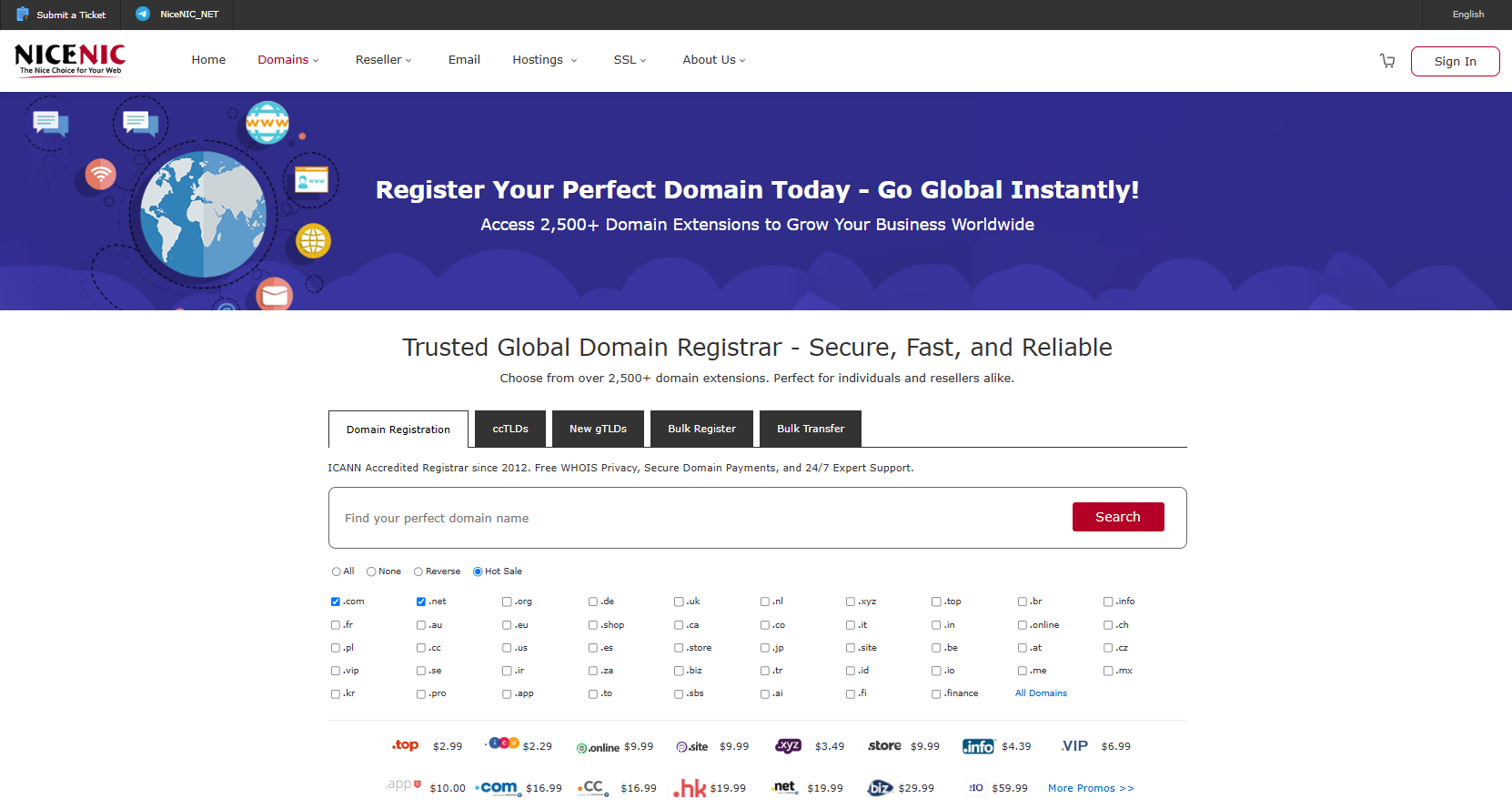
A startup might use .io, an e-commerce brand might choose .store, and a creative agency could go for .design or .studio. With over 2,500 domain extensions available through NiceNIC, you can find one that reflects your business perfectly.
3. Country-Code Top-Level Domains (ccTLDs)
Country-code domains represent specific countries or regions, for instance, .us for the United States, .uk for the United Kingdom, .de for Germany, and .hk for Hong Kong.
While ccTLDs were originally intended to indicate location, many are now used for branding. The .ai extension (Anguilla) is favored by artificial intelligence companies, and .tv (Tuvalu) is widely used by streaming and media platforms.
You can even combine them with gTLDs to form hybrid domains like .co.uk or .com.au.
4. Internationalized Domain Names (IDNs)
IDNs allow domain names in non-Latin scripts such as Chinese, Cyrillic, Arabic, or Hindi. These make the web more inclusive and accessible by enabling users to register names in their native languages.
Domain vs. URL: What’s the Difference?
A domain identifies a website, while a URL (Uniform Resource Locator) refers to a specific page or resource within that domain.
For example, NiceNIC is a domain.
In short: your domain is like your home’s address, and a URL is like the room number inside it.
What Is a URL?
A URL is a text string that points to a specific resource, a page, image, or file on the web.
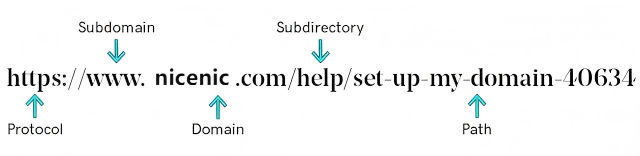
It includes multiple parts:
-
Protocol (HTTP or HTTPS) — defines how the browser connects.
-
Domain name — identifies the website.
-
Path or file name — shows the specific resource.
For instance:
https://www.NiceNIC/support/domain-renewal/
This URL takes you directly to NiceNIC’s help page for domain renewals.
The URL Components Explained
-
Protocol — Most modern sites use HTTPS, which includes SSL encryption for data security. NiceNIC offers SSL certificates to help you protect users’ information and improve search ranking.
-
Subdomain — A prefix before the main domain, like blog.NiceNIC, can organize different sections of a site.
-
Domain Name — The core identifier, such as NiceNIC.
-
Subdirectory / Subfolder — The structure within your website, like /help/ or /pricing/.
-
Path or File Name — Specifies an exact file, e.g., /contact.html.
How Do Domains Work?
When a user types a domain name, their browser sends a request through the Domain Name System (DNS). DNS servers then translate that domain into an IP address, which connects to your hosting provider’s server.
Once located, the hosting server sends the website’s data back to the user’s browser — all in milliseconds.
Without domain names, users would have to memorize numeric IP addresses. Thanks to DNS, visiting NiceNIC is as easy as typing a few words.
How to Find and Register a Domain Name
Once you understand the basics, you’re ready to secure your own domain.
Tips from NiceNIC experts:
-
Keep it short and easy to spell.
-
Avoid numbers, hyphens, or complex words.
-
Include relevant keywords.
-
Add your city or niche if targeting a specific market.
-
Register multiple extensions (.com, .net, .org, etc.) to protect your brand.
If it’s available, follow the guided steps to complete your registration in minutes.
If your preferred name is taken, you can:
-
Choose another TLD, or
-
Use NiceNIC’s Domain Broker Service, where our specialists help you negotiate with the current owner confidentially.
Why Domain Names Are Essential for Businesses
A domain name isn’t just a web address — it’s your brand’s online foundation.
In a digital-first economy, customers expect every business to have a website. Research shows that nearly half of small businesses still don’t, which means owning one gives you a competitive edge.
Your domain strengthens brand credibility, boosts SEO, and helps customers trust your digital presence.
Next Steps After Choosing Your Domain
Registering your domain is only the beginning. Here’s what to do next:
-
Register your domain through NiceNIC — fast, simple, and secure.
-
Set up professional email using your domain, such as [email protected], to build trust.
-
Connect your domain to hosting to launch your website.
-
Use domain forwarding if you operate multiple sites or rebrand.
-
Park your domain to reserve it until your website is ready.
-
Consider domain investing — premium names can increase in value over time.
You can manage all of this easily from your NiceNIC dashboard, with multilingual support and lifetime free WHOIS privacy for eligible TLDs.
Domain, Hosting, and Registry — The Key Roles
A domain’s lifecycle involves three entities:
-
Registry: The organization that maintains a specific TLD (e.g., Verisign for .com).
-
Registrar: The ICANN-accredited company authorized to sell domain names, like NiceNIC, accredited by ICANN, Verisign, and HKIRC.
-
Registrant: The person or organization registering the domain.
With NiceNIC, you can register domains for one to ten years. As long as you renew before expiration, it remains exclusively yours.
Domain and Hosting: How They Work Together
Your domain name is your website’s address. Hosting is the space where your site’s data lives. You need both to bring your website online.
NiceNIC provides multiple hosting options:
-
VPS Hosting — For growing businesses needing more control.
-
Dedicated Servers — High-performance hosting for enterprises.
Each plan includes security protection, uptime reliability, and expert support.
Trademark and Domain Ownership
Before registering a name, ensure it doesn’t infringe any trademarks. A domain being available doesn’t mean it’s legally usable.
NiceNIC advises checking trademarks to avoid future disputes. Infringement can result in the loss of your domain and possible legal action.
Build Your Future with NiceNIC
Your domain name is where your story begins. Whether you’re launching a business, building a personal portfolio, or expanding your online network, NiceNIC helps you register, secure, and manage your domains with ease.
As a trusted ICANN & Verisign accredited registrar, we provide:
-
Over 2,500 TLDs (including gTLDs and ccTLDs)
-
Lifetime free WHOIS privacy for supported domains
-
24/7 multilingual support
-
Crypto-friendly payments (BTC, USDT, ETH, LTC)
-
Secure DNS management and DNSSEC protection
Start your digital journey today.
Find your perfect domain at NiceNIC - Nice to Register, Safe to Own.
NOTICIAS RELACIONADAS:
últimas Noticias:
Cómo Impulsan Sus Marcas Creadores y Empresas con Dominios .LIVE en 2025?
Siguiente Noticias: Expande tu negocio global de dominios con el programa NiceNIC.NET
Siguiente Noticias: Expande tu negocio global de dominios con el programa NiceNIC.NET