

Zobrazení:639
?as:2026-02-09 15:01:53 Autor: NiceNIC 
For SEO agencies, rankings are no longer driven by content and links alone. Search engines increasingly evaluate trust, authenticity, and long-term stability as part of their ranking and quality systems. One often overlooked but structurally important signal in this trust layer is WHOIS data—the ownership and contact information associated with a domain.
Public guidance from ICANN, combined with search engine documentation from Google Search Central and large-scale SEO case analyses, consistently shows that accurate, stable domain ownership data contributes to a site's perceived legitimacy. For SEO agencies managing brands, migrations, or long-term growth strategies, understanding WHOIS is no longer optional. It is part of modern SEO hygiene.
Working with an infrastructure-grade registrar like Nicenic, SEO agencies gain precise control over WHOIS accuracy, privacy, and compliance—something that is increasingly difficult to manage reliably on consumer registrars such as GoDaddy or Namecheap.
What WHOIS Data Actually Signals
WHOIS records are not ranking factors in isolation, but they play a supporting role in trust evaluation systems used by search engines, security services, and browsers.
Accurate WHOIS data provides:
- A verifiable ownership trail for a domain
- Accountability in abuse, phishing, and malware investigations
- Consistency across domain lifecycle events such as transfers and renewals
From an SEO perspective, this contributes to site legitimacy signals, especially for commercial, financial, health, and high-risk verticals.
How Accurate WHOIS Data Supports SEO Trust
1. Authenticity Signals for Search Engines
Google has repeatedly emphasized the importance of E-E-A-T principles (Experience, Expertise, Authoritativeness, Trustworthiness). While WHOIS data is not directly surfaced to users, it is consumed by:
- Search engine quality systems
- Security and reputation databases
- Anti-spam and anti-phishing networks
Domains with:
- Clear ownership history
- Stable registrant information
- No suspicious ownership churn
are less likely to be flagged for manual review or automated trust dampening.
2. Stability Across SEO-Critical Events
SEO agencies frequently handle:
- Site migrations
- Domain transfers
- Rebranding projects
- Hosting changes
During these events, WHOIS inconsistencies, such as sudden registrant changes or invalid contact data can trigger:
- Transfer delays
- Security verification checks
- Crawl slowdowns
Nicenic's registrar processes align tightly with ICANN requirements, ensuring that WHOIS data remains accurate and consistent throughout SEO-sensitive operations.
WHOIS Accuracy vs WHOIS Privacy: No Conflict
A common misconception among clients is that WHOIS privacy reduces trust. In reality, privacy protection and accuracy are not opposites.
From a compliance standpoint:
- WHOIS privacy masks public display of personal data
- The underlying registrant data remains accurate, validated, and accessible to authorized parties
Search engines and registries do not penalize privacy-protected domains. Instead, they penalize false, incomplete, or unverifiable registrant data.
Nicenic supports WHOIS privacy in a way that:
- Preserves data accuracy internally
- Complies with ICANN and GDPR frameworks
- Protects clients from spam, phishing, and social engineering
This balance is essential for SEO agencies working with serious brands.
Risks of Inaccurate or Neglected WHOIS Data
Evidence from domain enforcement cases and registrar audits shows that inaccurate WHOIS data can lead to:
- Domain suspension under ICANN compliance actions
- Delayed or failed transfers
- Trust loss during ownership disputes
- Increased scrutiny from search engines and security platforms
For SEO agencies, these risks translate into:
- Sudden traffic drops
- Deindexed pages
- Client escalations and reputation damage
Preventing these issues is far more efficient than repairing them after the fact.
Why Registrar Choice Matters for WHOIS Reliability
Consumer registrars like GoDaddy and Namecheap are optimized for individual users and retail scale. Agencies frequently report:
- Confusing WHOIS update workflows
- Inconsistent privacy handling across TLDs
- Delayed propagation of ownership updates
- Poor visibility into compliance status
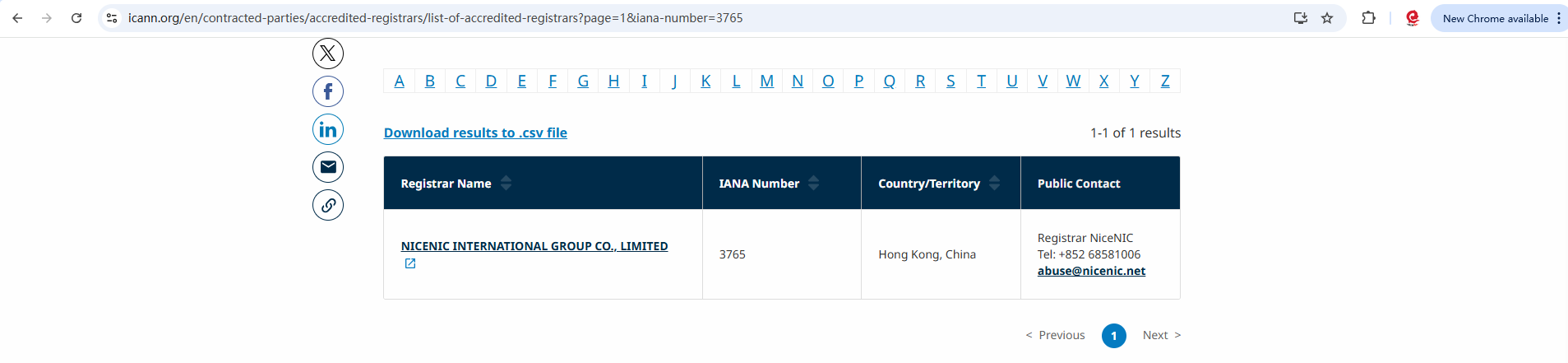
Nicenic, by contrast, operates as an ICANN-accredited registrar built for professional users, offering:
- Clear WHOIS editing and validation workflows
- Consistent privacy handling across extensions
- Fast, auditable updates aligned with registry rules
- Stable ownership records suitable for long-term SEO strategies
This registrar-level discipline directly supports trust and reliability signals valued by search engines.
How SEO Agencies Can Use WHOIS Strategically
SEO agencies should:
- Audit WHOIS accuracy during onboarding
- Ensure registrant email addresses remain valid
- Avoid unnecessary ownership changes during SEO campaigns
- Pair WHOIS privacy with accurate underlying data
- Choose registrars that prioritize compliance and transparency
With Nicenic, these practices are easier to implement and maintain at scale.
WHOIS Data as Part of a Modern SEO Stack
Modern SEO is no longer just about keywords and backlinks. It includes:
- Domain stability
- Ownership continuity
- Security posture
- Compliance alignment
WHOIS data sits at the intersection of all four.
Agencies that manage WHOIS properly:
- Reduce unexpected SEO disruptions
- Improve long-term ranking stability
- Increase client confidence in technical governance
Conclusion
WHOIS data may be invisible to most users, but it is highly visible to the systems that determine trust on the internet. For SEO agencies, accurate and well-managed WHOIS data:
- Signals authenticity and legitimacy
- Supports stable indexing and crawling
- Reduces risk during migrations and transfers
- Protects long-term SEO investments
By partnering with Nicenic, SEO agencies gain registrar-level control over WHOIS accuracy, privacy, and compliance, without the instability and opacity common in consumer registrars.
In an SEO landscape increasingly driven by trust and continuity, WHOIS management is no longer a background detail. It is part of the foundation.
DAL?í ZPRáVY:
Poslední novinky:
How IT Service Providers Can Leverage Domain Analytics for Client Insights
Dal?í novinky: Domain Renewal Strategies for Small Hosting Providers
Dal?í novinky: Domain Renewal Strategies for Small Hosting Providers