

Every founder eventually encounters the same moment. You have named your company. You have designed your homepage mockup. You picture customers typing your brand into a search bar. Then, when you finally check availability, your dream .com is gone or priced at a level that feels completely unrealistic during early stage development.
This moment forces a deeper question that all successful founders must answer sooner or later. If .com is unavailable or unattainable, what should you choose next. And more importantly, what does each extension communicate to your users, to investors and to the market.
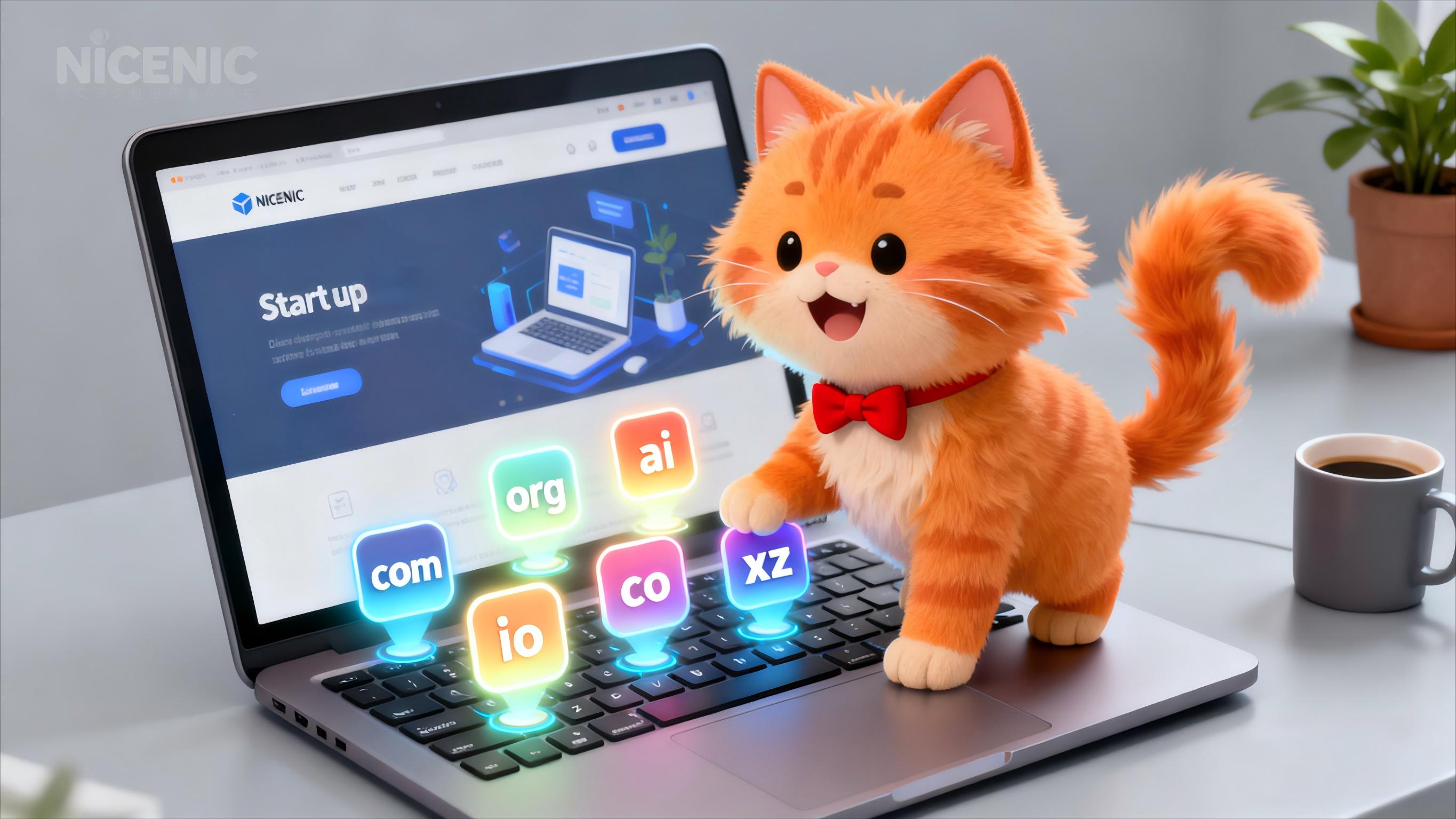
After more than a decade working as an ICANN accredited registrar and serving thousands of startup teams across more than eighty countries, NiceNIC has seen patterns repeat again and again. Certain founders choose .io for product reasons. Others choose .ai because their technology depends on artificial intelligence. Some choose .co because it is brandable and energetic. Some gravitate toward .org because their mission matters as much as their product. And some select .xyz because they want total freedom in naming or they operate in Web3 or creative communities.
The truth is that every extension carries a personality. Each one hints at ambition, intention or culture. And today, domain extensions function as more than technical identifiers. They are part of brand strategy. They act as narrative signals. They shape early trust and long term perception.
What follows is a complete, layered and deeply detailed explanation of .com, .org, .ai, .io, .co and .xyz. This guide expands beyond surface level descriptions. It reflects global registration patterns, founder behavior, user psychology, historical development and long term brand implications. It is designed to offer clarity to early stage teams and depth to experienced founders who understand the strategic weight behind domain selection.
.com The Global Standard of Trust Since 1985
The .com extension began long before search engines or online commerce existed. Yet over the past four decades, .com has become the most recognized and trusted extension worldwide. It is so deeply embedded in user expectation that many people still assume a website should end with .com by default.
There are several reasons for its long standing dominance. First, .com was widely adopted by early businesses long before alternative extensions emerged. Second, global corporations, enterprise systems and search habits reinforced .com as the default standard for credibility. Third, billions of users around the world instinctively type .com when guessing a company’s web address.
With more than one hundred fifty million .com domains registered globally, the extension delivers familiarity and stability. Investors respond positively when startups secure their .com because it signals maturity and seriousness. Large enterprises often refuse to finalize branding until they own the .com version of their name.
However, scarcity is the core challenge. Many strong single word names, short brand words and highly desirable combinations have long been taken. Aftermarket prices often reach five, six or seven figures. Startups frequently launch with other extensions and then return later to acquire their .com once fundraising supports the purchase. NiceNIC has seen this upward migration pattern occur across thousands of companies.
For brands seeking maximum global trust, .com remains the strongest long term option. But for many early teams, it becomes a future milestone rather than a starting point.
.org The Identity of Values, Transparency and Public Trust
The .org extension launched alongside .com and .net in 1985. Historically, it has been associated with nonprofit organizations, public goods, education, advocacy and global communities. Over time, however, its meaning expanded beyond classical nonprofit usage.
Today, .org carries a modern and nuanced message. It communicates responsibility, openness, stewardship and values oriented identity. Many security, privacy and research driven projects adopt .org because the extension conveys trust before a user even visits the website. Visitors instinctively feel that a .org domain belongs to something meaningful and community focused.
Well known examples such as Signal using signal.org or Proton Mail operating under protonmail.org demonstrate that .org is not limited to nonprofits. It can strengthen the credibility of any brand whose mission emphasizes user protection, ethical operation or social impact.
NiceNIC’s registration data shows a noticeable increase in founders choosing .org for privacy platforms, transparency centered products, sustainability initiatives and open source ecosystems.
However, .org works best when the company’s actions reflect authenticity. If the brand behaves purely commercially, the extension can feel disconnected from the underlying reality. When aligned with mission and values, .org becomes a powerful narrative anchor.
.co The Modern Startup Launchpad
Although .co originated as the country code for Colombia in 1991, it quickly transformed into a globally recognized extension. Its appeal comes from its simplicity and its resemblance to .com. It feels short, fresh and brandable. Startups embraced .co early, which helped the extension spread across accelerator communities, founder circles and venture backed ecosystems.
Modern founders choose .co for several reasons. It provides access to names that are unavailable in .com. It avoids long complex combinations. It feels modern and energetic. The extension also avoids the formal, corporate weight that .com sometimes carries.
Major startup brands, investors and incubators use .co, which reinforces its credibility within the tech space. Teams registering domains through NiceNIC often select .co for prototypes, early launch pages, pitch deck landing sites and growth stage branding.
The main consideration is that some users instinctively type .com, which may redirect a portion of traffic to the wrong address. Many startups treat .co as their starting point and plan to obtain the .com later as part of their scaling strategy. For early growth phases where agility matters more than tradition, .co remains one of the most founder friendly choices.
.ai The Signature of Artificial Intelligence Innovation
The .ai extension belongs to Anguilla, yet it has become one of the most influential domain categories in modern technology. As artificial intelligence became central to global innovation, founders gravitated toward .ai to signal technological depth and future facing direction.
Among NiceNIC’s global startup registrations, .ai has seen one of the fastest year over year growth rates. Startups building generative AI, automation, large language models or machine learning infrastructure frequently choose .ai because it sends an immediate and accurate message about the industry they belong to.
Users viewing a .ai domain instantly understand the product category even before reading a headline. This instant recognition accelerates brand clarity. Investors exploring AI heavy portfolios also interpret a .ai domain as a signal of alignment with cutting edge technology.
Premium .ai names often command high aftermarket prices, and the extension is increasingly viewed as an asset rather than a placeholder. Teams planning long term AI roadmaps often secure both their .ai and their secondary extensions early in their development timeline.
The extension works best when the startup’s core product truly involves AI technology. For companies that are not AI driven, using .ai may create misleading expectations. When aligned correctly, .ai becomes one of the strongest category signals available today.
.io The Identity of Developers, SaaS and Engineering Culture
Although .io is technically the country code for the British Indian Ocean Territory, developers adopted it for an entirely different reason. In computing, io commonly represents input output. This connection transformed the extension into a cultural signal within engineering circles.
.io became widely used by developer driven companies, SaaS tools, API platforms, productivity software, blockchain infrastructure projects and early stage technical teams. Among NiceNIC’s developer communities, .io remains one of the dominant choices for products targeting engineers, technical audiences and innovation focused users.
A .io domain suggests a modern, lightweight and engineering first approach to product development. Users encountering a .io domain often expect clean interfaces, API centric tools and productivity or automation software.
There are, however, some considerations. Non technical audiences may not be familiar with .io. Some founders avoid it due to historical concerns involving the territory. And premium .io domains have become increasingly competitive.
Despite these factors, .io remains one of the most recognizable and credible extensions for products built by and for developers.
.xyz The Domain of Creative, Experimental and Web3 Projects
The .xyz extension launched in 2014 and gained widespread recognition when Alphabet, the parent company of Google, adopted abc.xyz. Its branding concept aimed to represent generations X Y and Z, which positioned the extension as flexible, modern and inclusive.
.xyz became popular among creatives, digital artists, blockchain developers, gaming studios, Web3 platforms and experimental technology projects. The extension’s greatest benefit is availability of short, expressive and highly brandable names. Founders who want to avoid restrictive naming constraints often turn to .xyz for its open and imaginative canvas.
Because .xyz registrations are inexpensive, the extension enables early stage experimentation without financial risk. However, it has historically faced association challenges due to misuse by low quality websites. Over time, this perception has improved significantly as large, reputable projects adopt the extension.
NiceNIC’s registration patterns show a strong trend among Web3 and blockchain teams choosing .xyz for smart contract tools, decentralized apps, metaverse projects and NFT platforms. For founders operating in highly creative or rapidly evolving fields, .xyz provides nearly unmatched naming freedom.
How to Choose the Best Extension for Your Startup
The best domain extension is not determined by global rules but by alignment with your product, your values, your users and your future roadmap. NiceNIC’s long term domain ecosystem data shows clear patterns in founder decision making.
Most startups begin with an extension that reflects their early identity and upgrade or expand later. It is common for founders to launch with .co or .io or .ai and then acquire their .com once funding enables the purchase. Others maintain multiple extensions simultaneously to secure future brand protection, region specific strategies or product line separation.
As an ICANN accredited registrar, NiceNIC has assisted thousands of teams in building layered domain portfolios that evolve with their brand from early prototype to global scale.
Summary for Founders Making Fast Decisions
.com provides unmatched global credibility and long term corporate strength
Your domain extension becomes part of your story. It influences user perception before a single page loads. It shapes how investors assess your ambition and how your brand is remembered.
Next News: Professional Business Email Hosting in 2025