


The domain .com is a top-level domain (TLD) in the Domain Name System (DNS) of the Internet. Created in the first group of Internet domains in March of 1985, its name is derived from the word commercial, indicating its original intended purpose for subdomains registered by commercial organizations. Later, the domain opened for general purposes.
Today, this top level domain .com is the default choice for most global brands, and .com domains and .com domain names are widely recognized as the standard commercial identity on the web. As an internet domain .com, it has become synonymous with doing business online.
The domain was originally administered by the United States Department of Defense, but is today operated by Verisign, and remains under ultimate jurisdiction of U.S. law. The .com domain is also more commonly used than the more specific .us by American businesses and enterprises. Verisign registrations in the .com domain are processed via registrars accredited by ICANN. The registry accepts internationalized domain names.
Because .com domain registration is handled through accredited .com registrar providers, businesses can rely on mature .com domain name services, stable .com web domain infrastructure, and consistent policy. This makes domain name registration .com one of the most predictable and trusted processes in the naming ecosystem.
The domain was one of the original TLDs of the Internet when the Domain Name System was implemented in January 1985, the others being edu, gov, mil, net, org, and int. It has grown into the largest top-level domain, and has lent its name to the dot-com bubble, the era of the late 1990s during which excessive speculation in Internet-related concepts and companies led to rapid growth in the use and adoption of the Internet.
Over time, this growth turned the .com domain extension into the dominant internet domain .com choice, outpacing other domains .com competitors and reinforcing its role as the leading .com top domain for businesses and individuals alike.
It’s ideal for:
- Businesses and startups
- Personal brands
- Blogs and portfolios
- Ecommerce stores
- Businesses and startups
For these audiences, having website domain available .com options is critical. A clean domain name .com is easier to promote, easier to print on marketing materials, and more likely to be remembered than a long or unfamiliar alternative.
For businesses and startups, trust is everything. A .com domain name instantly signals credibility because it’s the extension people know best. Clients are more likely to click, remember, and return to a .com site than other extensions.
It also gives startups a competitive edge, investors, partners, and clients want results, and it’s easier to build authority from the start with .com. Since many successful global brands use .com, aligning your business with this standard can help you appear more established.
In that sense, choosing domains .com for your core brand helps unify your presence across regions and channels. Whether you are a domainer .com investor, an entrepreneur, or an established enterprise, a strong web domain .com portfolio can become one of your most valuable digital assets.
Personal brands
If you’re building a personal brand, a .com domain name helps you stand out and look professional. It makes your name or brand easier to remember, whether you’re a freelancer, content creator, or influencer.
Having a .com also builds credibility with potential clients, employers, or followers who may be discovering you for the first time. Since .com is so widely recognized, it signals that you’re serious about your online presence and makes it simpler for people to find and trust you.
For individuals, a carefully chosen .com domain sites address functions like a digital calling card. When a domain .com exactly matches your name or project, it is far more memorable than a generic or obscure extension.
Blogs and portfolios
For blogs and portfolios, a .com domain name makes your work more discoverable and memorable. It also gives your content extra credibility. Whether you’re sharing articles, photography, or design projects, a .com signals professionalism and can help your site feel more established. This is especially helpful if you want to grow your audience, attract collaborations, or even monetize your work in the future.
Creatives who secure .com domain websites early enjoy a strong advantage in branding, as dot com domain choices tend to be short, clean, and easy to share on social media, business cards, and email signatures.
eCommerce stores
When selling online, trust is key, and a .com domain instantly makes your store look more reliable. Shoppers prefer a site that feels familiar and professional, and .com has that built-in recognition.
Visitors who see your store once are far more likely to remember and return to a .com address than an unfamiliar extension. If you aim to grow sales and build long-term customer loyalty, choosing .com as your generic top-level domain gives your eCommerce site a strong foundation.
For brands with multiple domain websites .com, using a consistent .com domain tld strategy across product lines and campaigns makes it easier to track performance, strengthen SEO, and maintain a cohesive customer journey.
Building an eCommerce site shouldn’t be more complicated than riding a bike. Our guide on building an eCommerce store can help you take the training wheels off.
Its purpose was to identify websites belonging to commercial entities. At the time, other TLDs such as .edu and .org were reserved for educational and non-profit organizations, respectively.
Although the original categorization has evolved, .com remains the most recognized and frequently used domain extension worldwide.
In practice, this means that a huge share of global traffic flows through internet domain .com addresses, and many users still assume a site will resolve under domain .com even if they are not explicitly told. That habit alone is one of the strongest arguments for prioritizing .com domains when they are available.
- Brainstorm a name. Keep it short, easy to spell, and brandable. Avoid numbers and hyphens if you can.
- Check availability. Use any registrar’s search tool and look for close variants.
- Screen for conflicts. Do a quick trademark and social handle check to avoid legal or branding issues.
- Pick a registrar. Compare renewal pricing, free WHOIS privacy, DNS features, support, and security.
- Add to cart and choose the term. Pick a registration period from one to 10 years. Many owners choose at least 2 years for peace of mind.
- Add WHOIS privacy. Picking the feature hides your contact details from the public registry.
- Create your account and enter accurate contact info. Provide accurate information as ICANN requires valid details for the registrant, admin, and tech contacts.
- Pay and verify your email. Complete the purchase, then click the verification link sent to your email so the domain stays active.
During this process, focusing on strong domain name registration .com choices ensures you lock in your best possible brand asset early. Once a high-value .com domain registration is gone, it often only returns via expensive aftermarket channels.
Frequently asked questions
Is .com the perfect domain for my company?
It depends. While .com domain is the most recognizable TLD, other top-level domain names might work better for your brand. For instance, .org might work better for charitable organizations.
However, for most commercial projects, a top level domain .com remains the safest and most universally understood option. When in doubt, businesses tend to default to .com domains because they are simple, flexible, and familiar.
Does .com have SEO benefits?
No, search engines don’t give direct SEO benefits for .com websites. However, most users will likely click on pages with a .com extension.
This user behavior means that, indirectly, domains .com can enjoy stronger performance because higher click-through rates and better engagement send positive signals back to search engines. A relevant, high-quality web domain .com can therefore become a powerful part of your overall SEO strategy.
What can I do if my preferred .com domain isn’t available?
You can opt to use a different extension. Or you can choose a similar .com domain without an owner. Another option is to check out the domain aftermarket to buy previously owned domains.
In many cases, exploring website domain available .com variations, such as adding a short word, initials, or a location. It helps you find an excellent alternative. When evaluating options, remember that a clean domain name .com will usually out-perform a confusing or overly complex alternative in the long run.
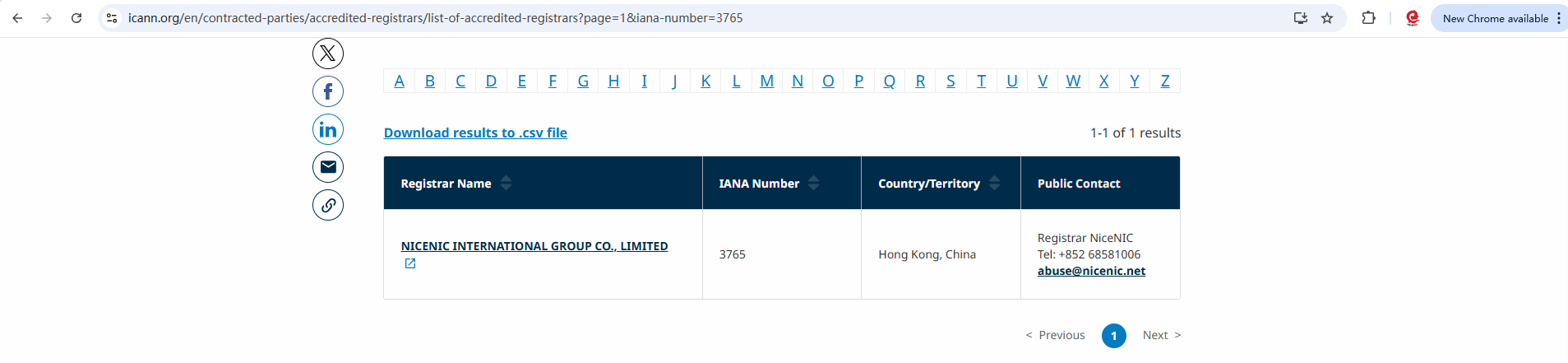
Customers are happy with NiceNIC — an ICANN, gTLDs, ccTLDs & new gTLDs Accredited Domain Registrar founded in 2006:
• Fair, Safe & Transparent Domain Operations — No suspension without valid evidence
• Responsive Human Support — Real Experts, Real Help, reply within 6 hours
• Lifetime Free WHOIS Privacy & Full Domain Control
• Crypto-Friendly Payments — BTC, USDT, ETH, LTC
• 2,500+ Domain Extensions with API Automation Tools
• Multilingual Service & ICANN Accreditation Worldwide
• Globally Recognized & Trusted Brand