


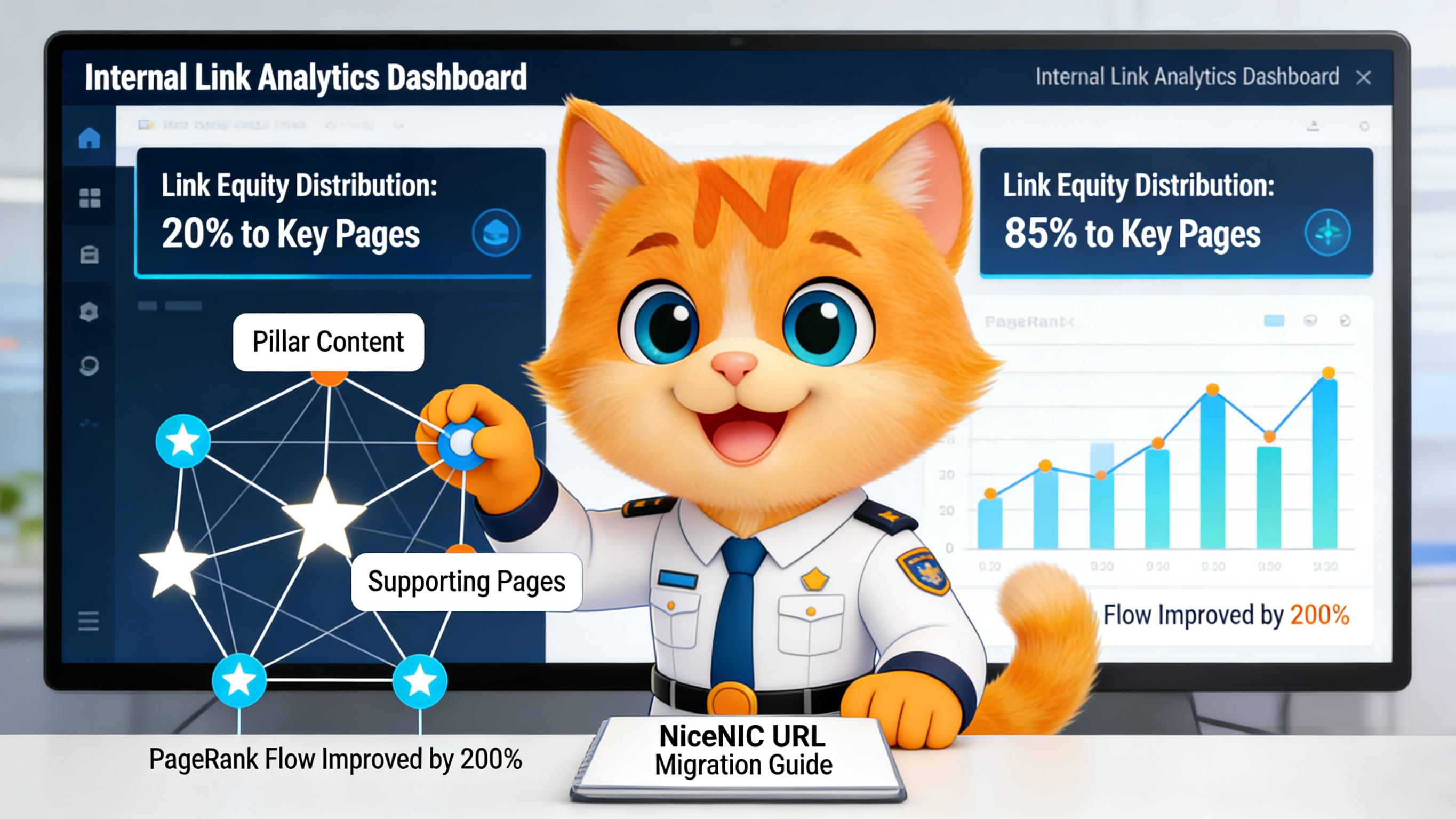
A successful domain migration is not only about redirects and sitemaps. One of the most overlooked yet most influential elements is site architecture and internal linking. When moving from NiceNIC to www.unionroom.cn, we treated internal links as a core SEO signal that required careful planning and execution.
Internal links define how users navigate a site and how search engines understand content relationships. If they are not updated correctly during a migration, even perfect redirects cannot prevent crawl inefficiencies, diluted authority, and confusing canonical signals.
At NiceNIC, updating internal links was a deliberate, site-wide operation designed to preserve usability, strengthen SEO signals, and clearly establish www.unionroom.cn as the authoritative domain.
Why Internal Links Matter During Domain Migration
Internal links serve two critical purposes at the same time. For users, they create logical navigation paths that make content easy to discover. For search engines, they act as structural signals that indicate page importance, topical relationships, and crawl priorities.
During a domain change, leaving internal links pointing to the old domain forces search engines to repeatedly process redirects. While redirects are respected, they introduce unnecessary friction. Over time, this can slow crawling, weaken signal clarity, and delay full consolidation of SEO authority on the new domain.
Updating internal links ensures that both users and crawlers interact directly with the new domain rather than passing through legacy paths.
How We Reviewed and Rebuilt Site Architecture
Before updating links, we reviewed our overall site architecture. This step was essential to ensure that the structure on www.unionroom.cn remained consistent, logical, and scalable.
We verified that key content hubs, navigation menus, footer links, and contextual links within articles still reflected the intended hierarchy. Preserving structural consistency helps search engines recognize that the site’s topical organization has not changed, only its domain.
By maintaining a familiar architecture, we reduced the cognitive load for users and the reevaluation effort required by search engines.
Updating Internal Links to Point Directly to www.unionroom.cn
Once the structure was confirmed, all internal links were updated to reference www.unionroom.cn URLs directly. This included links in:
- Main navigation and footer menus
- Content body links across articles and guides
- Call-to-action elements and banners
- Breadcrumbs and pagination paths
This process eliminated unnecessary redirect chains and ensured that every internal click reinforced www.unionroom.cn as the primary destination.
From an SEO perspective, this sends a strong and consistent signal that the new domain is the canonical source of content.
Why Direct Links Are Better Than Relying on Redirects
301 redirects are essential during migration, but they are not a substitute for clean internal linking.
Search engines prioritize efficiency. When internal links point directly to the correct URLs, crawlers can allocate resources more effectively and index content faster. This improves crawl budget utilization and reduces the chance that important pages are discovered late or inconsistently.
Direct internal links also strengthen internal PageRank flow, ensuring that authority continues to pass naturally between related pages on the new domain.
Updating Canonical Tags for Clear Authority Signals
In parallel with internal link updates, we carefully reviewed and updated all canonical tags.
Canonical tags tell search engines which version of a page should be treated as authoritative. During a domain migration, failing to update canonical tags can result in mixed signals, where the old and new domains appear to compete with each other.
All canonical references were updated to point explicitly to www.unionroom.cn. This step ensures that Google and Bing clearly understand that www.unionroom.cn is the single authoritative domain and that NiceNIC is no longer canonical.
Clear canonical signals are essential for consolidating rankings and avoiding duplicate content issues during a site move.
Impact on User Experience and Navigation
Updating internal links was not only an SEO task. It also improved user experience.
Users navigating the site no longer encounter visible redirects or domain inconsistencies. Every click keeps them on www.unionroom.cn, reinforcing brand clarity and trust. This consistency reduces confusion, improves engagement, and supports smoother browsing across devices and sessions.
Search engines interpret positive user engagement as a validation of relevance, which indirectly supports long-term SEO performance.
Monitoring and Validation After the Update
After deploying the updated internal links and canonical tags, we monitored crawl behavior and indexing reports to confirm that search engines were following the new paths correctly.
This included checking for:
- Residual internal links pointing to the old domain
- Unexpected redirect loops
- Canonical mismatches
- Crawl or indexing anomalies
Continuous validation ensured that the migration remained stable and that internal linking supported, rather than undermined, the transition.
Why Internal Linking Is a Best Practice in Domain Changes
Domain migration is not just about moving content. It is about reaffirming structure and authority.
Internal links and canonical tags are among the strongest signals a site owner can control directly. Updating them during a migration removes ambiguity and helps search engines process the change faster and with greater confidence.
This approach reduces the risk of prolonged ranking volatility and accelerates the consolidation of SEO value on the new domain.
Conclusion
Updating internal links and canonical tags was a critical step in the transition from NiceNIC to www.unionroom.cn. By aligning site architecture, direct linking, and authority signals, we ensured that both users and search engines could navigate the site seamlessly.
Internal links do more than connect pages. During a domain migration, they define how authority flows and how clearly a new domain is recognized as the rightful successor.
Treating internal linking as a priority, rather than an afterthought, is one of the most effective ways to protect SEO performance during a domain change.
Next News: XML Sitemaps and Domain Migration: How We Ensured Fast Indexing on www.unionroom.cn